Bleeding Gums, Stubborn Arteries: The Dental Appointment Men Keep Skipping
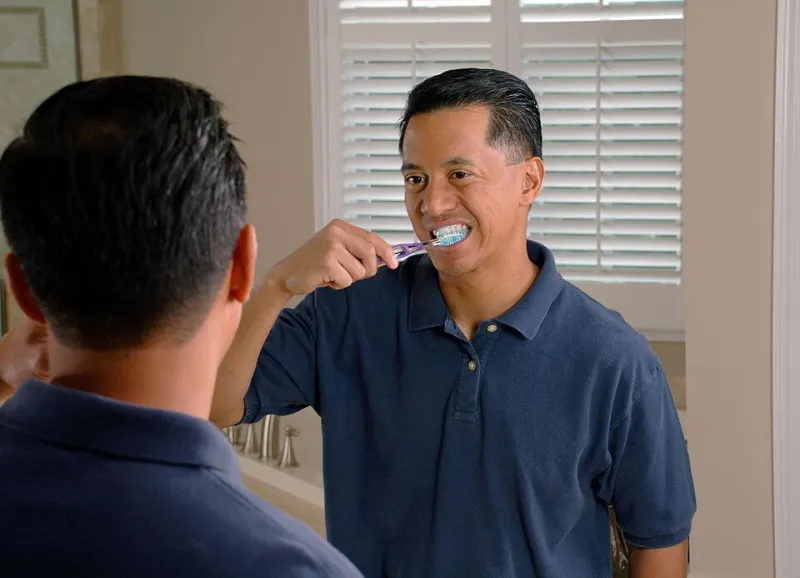
Photo: Bill Branson (Photographer), Public domain, via Wikimedia Commons
You notice it in the sink. A little pink when you spit. Maybe a twinge when you bite into an apple. It goes away in a day, so you file it under things that are not a problem yet — the same folder where most guys keep their entire preventive health strategy.
Meanwhile, roughly six years have passed since your last dental cleaning, and you have developed a firm opinion about how the floss is basically a scam.
Let's unpack both of those, because gum disease is one of the few men's health issues where the symptoms are visible in a mirror and the downstream conversation is about your arteries.
First, the numbers
Periodontal disease — the clinical term, covering everything from reversible gingivitis to bone loss around the teeth — affects nearly half of US adults 30 and older, according to CDC data. Men carry a higher burden than women. Men are also more likely to skip dental visits entirely, and the gap widens in the years when careers, kids, and the general business of being a guy crowd out a Tuesday morning appointment.
That matters because periodontitis is not a hygiene embarrassment. It is a chronic inflammatory condition, and chronic inflammation is the thread that runs through a lot of what goes wrong in a 45-year-old male body.
What the evidence actually shows
The reasonable mechanism goes like this. Gum tissue in a diseased pocket is a raw, vascular surface. Chewing, brushing, even a dental cleaning can push oral bacteria into the bloodstream — a transient bacteremia that happens to everybody, but more aggressively when the gums are inflamed. The body responds with systemic inflammation. Markers like high-sensitivity CRP drift upward. Some periodontal pathogens, notably Porphyromonas gingivalis, have been studied for their effects on endothelial cells, the lining of your blood vessels.
Observational research has repeatedly linked moderate to severe periodontitis with higher rates of cardiovascular events, stroke, and — relevant to this particular website — erectile dysfunction, which is often an early signal of endothelial trouble.
Now the caveats, and they are big. These are associations, not proof of cause. The same factors that wreck your gums also wreck your arteries: smoking, heavy drinking, poor diet, diabetes, low income, and limited access to care. Teasing apart gum bacteria from a pack-a-day habit is genuinely difficult. Trials of periodontal treatment do tend to show modest improvements in inflammatory markers, but nobody has run the large, decades-long randomized trial that would prove treating gums prevents heart attacks.
Which leads to the honest conclusion: treat your gums for your gums. Treat your heart for your heart. Do not skip the statin because you got a deep cleaning, and do not treat a dental appointment as cardiac insurance. The association is real enough to take seriously and not strong enough to replace anything.
The appointment you keep rescheduling
A routine cleaning and exam runs somewhere around $100 to $150 in most US markets without insurance, and often less with a new-patient special. X-rays add $50 to $150. If there is bone loss and deep pockets, scaling and root planing — the deep cleaning — runs a few hundred dollars per quadrant.
All of it is an eligible HSA and FSA expense. Which means the guy who funnels his health account into supplement bottles is also the guy leaving tax-free money on the table for the one appointment that comes with a visible early-warning system.
Questions worth asking in the chair
Most men sit through a cleaning, nod at the small talk, and leave without asking a single clinical question. Ask these:
- What are my probing depths? Anything at 4 millimeters or more, and especially 5 and above, is worth tracking by number over time.
- What percentage of sites bled on probing? This is the cleanest single measure of active inflammation. Ask for the number.
- Is there bone loss visible on the X-rays compared with my last set?
- Do I actually need scaling and root planing, or a routine cleaning?
- Am I grinding? Recession, flattened chewing surfaces, and jaw soreness point to a night guard, which is also HSA-eligible.
Then take it to your primary care visit. Mention gum disease the way you would mention a family history of heart attack — it belongs in the record. Ask for high-sensitivity CRP alongside your lipids, an A1c, and a blood pressure reading that isn't taken in a hurry. If your gums are actively inflamed, that context helps a clinician interpret an elevated inflammatory marker instead of ordering a round of follow-up imaging.
The cheap stuff that actually works
None of this requires a $200 electric toothbrush with an app.
- Two minutes, twice a day. A $30 to $60 rechargeable brush with a timer beats a manual brush for most people, mostly because it enforces the timer.
- Clean between the teeth. Floss or interdental brushes. The evidence is strongest for interdental cleaning reducing bleeding, and the technique matters more than the brand.
- Fluoride toothpaste, and don't rinse afterward. Spit, don't wash the fluoride away.
- Watch the sipping. Energy drinks, soda, and sweetened coffee taken slowly all day bathe the gums in sugar and acid. Frequency matters more than volume.
- Nicotine is the biggest single lever. Smoking and vaping both reduce blood flow to gum tissue, which is why smokers can have advanced disease with almost no bleeding. If you quit, both your gums and your arteries get the benefit.
- Hydrate, especially if you're on stimulants. Dry mouth from ADHD meds, decongestants, or a pot of coffee before noon makes everything worse. Xylitol gum is a cheap countermeasure.
- Book the next one before you leave the building. The six-month recall is not a scam. It is the entire mechanism by which early problems get caught while they are still cheap.
Your gums bleed because something is inflamed, and you can see it in the sink every morning. Your arteries don't offer that courtesy. Start with the one that talks to you.