The Dad Bod Isn't a Joke — It's a Hormone Receipt
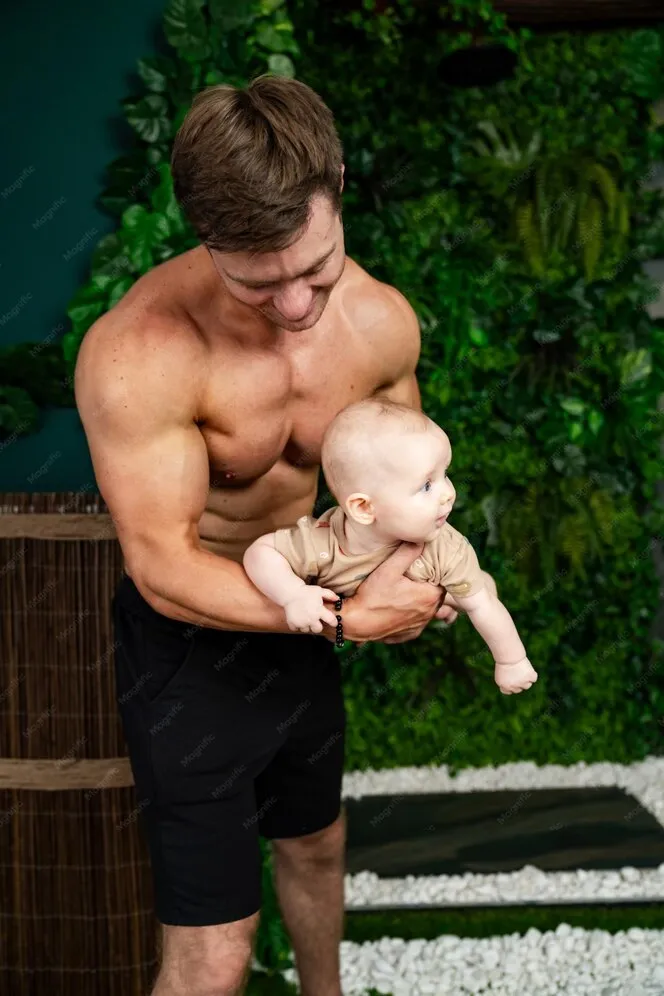
Photo: tired father holding baby in home gym, candid lifestyle photo, via img.freepik.com
Nobody hands you a pamphlet at the hospital that says, 'Congratulations — your testosterone is about to drop 30% and your sleep is now optional.' But that's roughly what happens when a guy becomes a dad.
We've all seen the meme: the beer gut, the minivan, the 'dad bod.' What almost nobody talks about is that the dad bod isn't just a lifestyle punchline. It's a measurable physiological shift — and it's happening to millions of American men with zero marketing budget behind it.
The Science Nobody Put on the Baby Registry
Researchers have known for a while that fathers experience hormonal changes. Studies out of Northwestern and elsewhere have found that men's testosterone levels decline after becoming fathers — possibly an evolutionary nudge toward nurturing over competing. Fine in theory. Less fine when your energy, muscle mass, and mood all ride on that hormone.
Then there's sleep. A newborn costs the average parent somewhere between 400 and 700 hours of sleep in the first year. Chronic sleep restriction does a number on men specifically: it tanks insulin sensitivity, spikes ghrelin (the 'feed me' hormone), and drags down testosterone further. You're not weak-willed for crushing a bag of chips at 11 p.m. — you're chemically primed to.
Add cortisol — the stress hormone that stays elevated when you're juggling a career, a mortgage, and a toddler who thinks 5 a.m. is a personality trait — and you've got a perfect metabolic storm. Stress eating plus muscle loss plus terrible sleep equals the four pounds a year that quietly become forty.
We Asked Actual Dads
Marcus, 34, a project manager in Columbus, put it plainly: 'I didn't get fat because I stopped caring. I got fat because I stopped having a single hour to myself. The gym membership didn't lapse because of laziness. It lapsed because there was no version of my schedule where it fit.'
Guys like Marcus are the blind spot of the entire men's health industry. Walk into any supplement expo and you'll see products for shredded 22-year-olds, for biohacking executives, for competitive lifters. What you won't see is anything marketed to a man who hasn't slept four consecutive hours since March.
That's ironic, because exhausted fathers are arguably the demographic with the most to gain from a real plan — and the least time to research one.
What Endocrinologists Actually Recommend
We spoke with a board-certified endocrinologist (who asked to remain unnamed so she could speak frankly about the supplement industry) and her advice was refreshingly unglamorous.
'If a new dad asks me for a testosterone booster, I tell him the truth: the cheapest intervention is a sleep schedule you protect like a prescription,' she said. 'Trade shifts with your partner. One full night of uninterrupted sleep, minimum, twice a week. That alone will do more than any bottle on the shelf.'
Her hierarchy of what actually moves the needle:
- Sleep blocks. Split the night into shifts. Protect them like meetings you can't cancel.
- Protein first. Stress eating is usually a blood sugar problem. Eat 30–40 grams of protein at breakfast and the 3 p.m. vending machine run loses its grip.
- Strength training, twice a week, 30 minutes. Not for aesthetics — for insulin sensitivity and testosterone maintenance.
- A real blood panel. Get your testosterone, thyroid, and vitamin D checked at your annual physical, not from a mail-order 'optimization' clinic.
Notice what's missing? A $60 bottle of anything.
The Trainer's Version: Fitness in the Gaps
Certified strength coach Derek Alvarez trains a lot of fathers in his Denver gym, and his approach is built around one word: fragments.
'New dads think if they can't do an hour, it doesn't count,' Alvarez says. 'Wrong. Three ten-minute blocks — push-ups during nap time, a brisk walk with the stroller, a dumbbell circuit while dinner's in the oven — that's a real training week. The barbell doesn't care if you're wearing a baby carrier.'
His other rule: never re-start where you left off. 'The guy who used to bench 315 and tries to pick up at 225 on week one gets injured and quits by February. Start at the weight that feels almost insulting. Consistency is the whole game.'
Why No One's Selling to You — and Why That's Fine
Here's the uncomfortable truth about the supplement industry: exhausted fathers are a terrible target market. You're price-sensitive, you're skeptical, and you don't have the bandwidth to believe a marketing claim. So the industry sells 'male vitality' to insecure 24-year-olds instead.
Honestly? That might be a blessing. Because the interventions that work for dads are free or cheap: sleep shifts, protein, two short lifting sessions, a walk that doubles as stroller duty, and an actual conversation with your doctor instead of a group chat diagnosis.
Fatherhood rewires your body. It also rewires your priorities — and the guys who come out the other side fitter aren't the ones who found a magic pill. They're the ones who built a system that survives a 3 a.m. feeding.
The dad bod isn't destiny. It's a receipt. And you're allowed to get a refund — one nap at a time.
This article is for informational purposes only and isn't medical advice. Talk to your physician before making changes to your health routine.